Introduction
Email marketing is one of the most powerful and cost-effective tools in digital marketing. It allows businesses, entrepreneurs, and even students to communicate directly with their audience, promote products or services, build relationships, and drive conversions. Despite the rise of social media and instant messaging platforms, email remains a crucial communication channel, particularly for marketing purposes.
This article explains what email marketing is, how it works, and provides a practical example to illustrate its use and effectiveness.
1. What is Email Marketing?
Email marketing is a digital marketing strategy that involves sending emails to a group of people to promote products, share information, nurture relationships, or encourage specific actions like buying, signing up, or clicking a link.
At its core, email marketing involves sending valuable content to subscribers who have willingly provided their email addresses, usually in exchange for a benefit like updates, offers, a free download, or a newsletter.
Key Objectives of Email Marketing:
-
Promote products or services.
-
Increase brand awareness.
-
Inform and educate the audience.
-
Nurture leads into paying customers.
-
Retain existing customers through loyalty campaigns.
-
Drive traffic to websites or landing pages.
2. Why is Email Marketing Important?
Email marketing offers numerous advantages, especially for small businesses, students, content creators, and affiliate marketers:
-
High Return on Investment (ROI): According to a report by Litmus, the average ROI for email marketing is $36 for every $1 spent.
-
Direct Communication: Unlike social media where algorithms control visibility, email goes straight to the user’s inbox.
-
Personalization: Emails can be customized based on user interests, behavior, and purchase history.
-
Automation: Entire campaigns can be set to run automatically based on user actions.
-
Measurable Results: Tools like open rates, click-through rates, and conversion tracking help measure success.
3. How Does Email Marketing Work?
To understand how email marketing works, let’s break it down into several steps or components:
Step 1: Build an Email List
You can’t do email marketing without an audience. The first step is collecting email addresses from people interested in your niche, product, or service. This is usually done using lead magnets such as:
-
Free eBooks or downloadable resources.
-
Exclusive discounts or coupons.
-
Access to webinars or training.
-
Contests and giveaways.
How to Collect Emails:
-
Add opt-in forms to your website or blog.
-
Use pop-up boxes or landing pages.
-
Collect emails through social media or YouTube descriptions.
-
Ask website visitors to subscribe to your newsletter.
Important: Always use permission-based email collection to comply with privacy laws like GDPR and CAN-SPAM Act.
Step 2: Choose an Email Marketing Platform
Email marketing software helps you send, manage, and automate emails. Popular platforms include:
-
Mailchimp (beginner-friendly)
-
ConvertKit (ideal for creators)
-
Sendinblue
-
ActiveCampaign
-
GetResponse
These platforms offer tools such as:
-
Drag-and-drop email builders.
-
Subscriber segmentation.
-
Automation workflows.
-
Analytics and reporting.
-
Pre-designed templates.
Step 3: Segment Your Audience
Segmentation means dividing your email list into smaller groups based on specific criteria such as:
-
Interests or purchase behavior.
-
Location.
-
Age or profession.
-
How they joined your list.
For example, if you’re running a blog about travel, you might segment users into:
-
Backpackers
-
Luxury travelers
-
Family vacationers
Why Segment? Because personalized emails perform better. Studies show that segmented campaigns get 14.31% more opens and 100.95% more clicks than non-segmented campaigns.
Step 4: Create Compelling Email Content
Your emails must be engaging and relevant. A typical email contains:
-
Subject Line: The first thing the recipient sees — must be catchy and informative.
-
Preheader Text: A brief summary that appears next to the subject.
-
Header: The main heading inside the email.
-
Body Content: The actual message. It may contain images, text, videos, or links.
-
Call to Action (CTA): What you want the reader to do (click a button, read an article, make a purchase, etc.)
Types of Emails You Can Send:
-
Welcome emails
-
Promotional emails
-
Newsletters
-
Educational content (how-to guides, tips)
-
Transactional emails (invoices, order confirmations)
-
Re-engagement emails
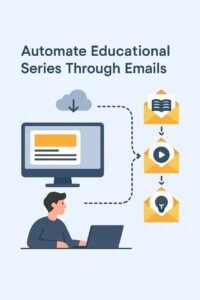
Step 5: Automate Email Campaigns
Automation allows you to send emails based on specific triggers. For example:
-
A welcome email series sent after someone subscribes.
-
A reminder email if someone abandons their shopping cart.
-
A follow-up email after a purchase.
This makes email marketing efficient and scalable. Tools like ConvertKit and ActiveCampaign specialize in building complex email automation sequences.
Step 6: Analyze and Optimize
Every good email marketing campaign ends with performance analysis. You can track metrics like:
-
Open rate: Percentage of recipients who opened the email.
-
Click-through rate (CTR): Percentage of recipients who clicked on a link.
-
Conversion rate: How many completed the desired action (e.g., purchased something).
-
Unsubscribe rate: How many opted out.
Use this data to improve future campaigns by:
-
A/B testing subject lines or content.
-
Sending at optimal times.
-
Rewriting low-performing CTAs.
Benefits of Email Marketing
Let’s summarize some of the primary advantages:
| Benefit | Explanation |
|---|---|
| Cost-effective | Low-cost compared to other channels |
| Easy to start | Many free tools are available for beginners |
| Customizable | Design emails to match your brand |
| Highly targeted | Segment audiences for precision |
| Trackable results | Real-time analytics and data |
| Builds relationships | Regular communication nurtures trust |
| Drives conversions | Emails with CTA buttons can directly lead to sales |
Real-Life Example: Using Email Marketing for Affiliate Sales
Meet Rahul – A Student Affiliate Marketer
Rahul, a college student, runs a blog on productivity tools for students. He writes reviews and tutorials about time management apps, note-taking tools, and educational platforms.
Here’s how Rahul uses email marketing effectively:
1. Building His List
Rahul offers a free downloadable resource on his blog titled “Top 10 Study Tools Every Student Should Use”. To download it, visitors must enter their name and email.
2. Welcome Series
When someone subscribes, they receive a series of 3 automated emails:
-
Email 1 (Immediately): Welcome and download link.
-
Email 2 (Day 2): Tips on using productivity apps effectively.
-
Email 3 (Day 4): A review of his favorite tool with an affiliate link.
3. Weekly Newsletters
Every week, Rahul sends a newsletter with:
-
A link to his latest blog post.
-
Discount offers from affiliate partners.
-
A short motivational tip for students.
4. Affiliate Promotion Campaigns
Once a month, Rahul runs a dedicated campaign around a single product. For example, promoting a premium version of an app like Notion, which offers student discounts. His email:
-
Highlights the benefits of the app.
-
Shares a personal success story.
-
Includes an affiliate link.
5. Result
After 6 months:
-
He grew his email list to 2,500 subscribers.
-
His average open rate is 32%.
-
He earns ₹12,000–₹15,000/month through affiliate links clicked from his emails.
Conclusion
Email marketing is a highly effective and affordable strategy to connect with your audience, build long-term relationships, and drive engagement or sales. For students, bloggers, content creators, or businesses, email remains an essential tool to grow influence, monetize content, and communicate value directly.
The process starts with building a quality list, choosing the right platform, crafting relevant and engaging emails, and continuously optimizing based on analytics. Through tools like automation, segmentation, and personalized content, email marketing becomes not just a channel — but a smart, scalable system for building a sustainable digital business.
As the example of Rahul shows, even a student with a small website and limited time can use email marketing to generate consistent income, build authority, and support career growth. All it takes is consistency, creativity, and a willingness to learn.