Revolutionize Engagement: How Smart Devices Supercharge Email Marketing Success
The rise of voice-activated and smart devices, such as Amazon Echo, Google Home, and smartphones with virtual assistants like Siri and Alexa, is reshaping how consumers interact with technology. These devices, powered by artificial intelligence (AI) and machine learning (ML), offer new opportunities for email marketing to evolve beyond traditional inbox-based campaigns. By ensuring that Devices Integrate with Email Marketing, brands can make campaigns more interactive, accessible, and contextually relevant, enhancing user engagement while adapting to changing consumer behaviors.
Experience the Future: How Smart Devices Are Transforming Email Marketing for Good
The Empowering Role of Voice and Smart Devices in Modern Consumer Behavior
Voice and smart devices have become integral to daily life, with over 4.2 billion voice assistants in use globally by 2024, according to Statista. These devices enable hands-free, conversational interactions, making them ideal for multitasking consumers who seek convenience. Smart devices, including wearables and IoT-enabled appliances, collect real-time data on user behavior, preferences, and context, creating opportunities for hyper-personalized marketing.
To stay relevant, marketers must ensure Devices Integrate with Email Marketing to meet modern consumer expectations. Consumers increasingly use voice commands to check emails, shop online, or manage tasks, with 62% of U.S. adults using voice assistants for daily activities, per a 2023 Pew Research study. This means integrating email marketing with these devices allows brands to reach users in new contexts—while cooking, driving, or exercising—enhancing accessibility and engagement.
Mechanisms of Integration
1. Voice-Activated Email Interaction
Voice assistants enable users to interact with emails using natural language commands. For example, users can say, “Alexa, read my emails” or “Siri, open my promotions folder,” allowing hands-free access to marketing emails. AI-powered assistants can summarize content, highlight key offers, or prompt users to take actions like “Reply with ‘Yes’ to claim this deal.”
This shift signifies the importance of ensuring Devices Integrate with Email Marketing for more conversational and user-centric engagement.
To integrate effectively:
-
Optimize for Voice: Emails should be crafted to sound natural when read aloud.
-
Enable Voice Actions: Include voice-friendly CTAs such as “Say ‘Order now’ to buy.”
-
Leverage NLP: Ensure assistants accurately interpret and communicate content.
When Devices Integrate with Email Marketing, the results are more interactive and accessible campaigns that capture consumer attention in real time.
2. Smart Device-Triggered Emails
Smart devices, such as fitness trackers, smart fridges, or connected vehicles, generate real-time behavioral data that can trigger personalized emails. For example, if a fitness tracker notes high activity, it may trigger a promotional email for athletic gear.
Here, Devices Integrate with Email Marketing to deliver highly contextual messaging. For instance, a smart fridge detecting a low milk supply could prompt a coupon email from a local grocery store.
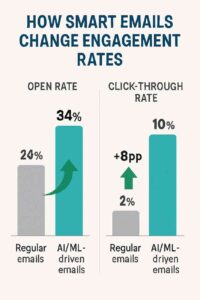
The integration helps ensure timely engagement. A 2023 Salesforce study highlighted that triggered emails, especially those where Devices Integrate with Email Marketing, have open rates of up to 45% and click-through rates between 10% and 20%.
3. Personalized Recommendations via Smart Devices
AI-powered personalization is even more effective when Devices Integrate with Email Marketing. Smart thermostats, wearables, and virtual assistants feed data that makes email content more relevant. For instance, cold weather detected by a smart thermostat can prompt emails recommending winter clothing.
When Devices Integrate with Email Marketing, they deliver precisely what users need, when they need it. A voice assistant tracking travel-related queries may trigger flight promotions, making campaigns more intuitive and responsive.
According to a 2023 HubSpot report, personalized emails lead to 26% higher open rates and 14% more CTRs. This impact amplifies significantly when smart Devices Integrate with Email Marketing to harness behavioral data.
4. Interactive Email Experiences
By design, smart Devices Integrate with Email Marketing to enable interactivity. A smartwatch might alert a user to a time-sensitive deal, or a smart speaker could invite participation in a quiz or voice-based poll.
For example, an email might read, “Take our two-question quiz using Alexa and win 20% off.” As Devices Integrate with Email Marketing, users can engage hands-free, making it a frictionless, conversational experience.
A 2022 Experian study revealed that interactive emails have an 18% higher CTR than static ones. Ensuring Devices Integrate with Email Marketing allows marketers to tap into this interactive potential with ease.
5. Cross-Device Integration
Amazon Echo, Fire TV, and Kindle often work as part of a broader ecosystem. When these Devices Integrate with Email Marketing, users can begin an interaction on one device and complete it on another—such as starting a purchase on a phone and confirming it via a smart speaker.
This ecosystem-wide integration boosts engagement. A 2023 DMA study reported that campaigns using multichannel touchpoints, especially where Devices Integrate with Email Marketing, yield 30% higher engagement rates than single-channel efforts.
Challenges of Integration
Even though Devices Integrate with Email Marketing offers many benefits, the path is not without obstacles:
-
Privacy Concerns: Smart devices gather personal data. When Devices Integrate with Email Marketing, ensuring GDPR and CCPA compliance is non-negotiable.
-
Technical Barriers: Implementing APIs, ensuring data synchronization, and enabling seamless voice interpretation are all complex tasks when Devices Integrate with Email Marketing.
-
Content Reformatting: Emails must be voice-optimized to avoid confusion when read aloud by AI.
-
User Overload: Overuse of device notifications can fatigue users, diminishing returns.
-
Accessibility Gaps: Not all users have smart devices, so Devices Integrate with Email Marketing must coexist with traditional channels to maintain inclusivity.
Example: A Grocery Retailer’s Smart Email Campaign
Take FreshMart, a grocery chain aiming to increase online engagement. They invest in an AI platform to ensure Devices Integrate with Email Marketing, particularly through Alexa and smart fridges.
Their Strategy Includes:
-
Voice-Activated Email Access: Users say “Alexa, read my FreshMart emails” to hear about deals or recipes.
-
Smart Fridge Triggers: When milk runs low, the fridge triggers a FreshMart email with a discount and shopping list.
-
Real-Time Recommendations: Based on shopping history and device data, users receive cooking suggestions.
-
Cross-Device Flow: Shoppers add items via voice or screen from an email to their smart shopping list.
FreshMart’s case shows what’s possible when Devices Integrate with Email Marketing. Within six months, FreshMart sees open rates jump to 40%, CTRs rise to 10%, and a 25% increase in sales.
Customer feedback also emphasizes the importance of transparency. As Devices Integrate with Email Marketing, FreshMart updates its privacy policies, allowing users to manage device-linked preferences easily.
Strategies for Success
To make the most of scenarios where Devices Integrate with Email Marketing, marketers should:
-
Optimize for Voice: Use conversational, clear language.
-
Trigger in Context: Send messages when device activity suggests user readiness.
-
Ensure Transparency: Always request permission to collect and use device data.
-
Run Pilot Campaigns: Test integrations with small segments before scaling.
-
Offer Choice: Keep standard email formats available for non-device users.
These best practices ensure that Devices Integrate with Email Marketing responsibly and effectively, maximizing ROI.
Conclusion
As more Devices Integrate with Email Marketing, brands can create deeply personalized, interactive, and real-time campaigns. With the ability to deliver relevant content during users’ daily routines—driving, cooking, or relaxing—voice and smart devices are redefining digital outreach.
Although challenges exist, such as privacy concerns and tech barriers, the potential gains in engagement and revenue are enormous. FreshMart’s success proves that when Devices Integrate with Email Marketing strategically and transparently, customer satisfaction and brand loyalty grow significantly.
The future of marketing is voice-enabled, data-driven, and omnipresent. Businesses that embrace this shift—ensuring their Devices Integrate with Email Marketing effectively—will stand out in a competitive digital landscape.